
URBAN WAVE

BIRMINGHAM
Step into a Smarter City
We propose a number of changes to the inner city of Birmingham and the development of smart urban planning with respect to the inevitable introduction of driverless cars. Our intention is to begin the main infrastructure changes along two routes specifically which are indicated on the maps adjacent.

Route 1
WHO: Adapted route for conventional and driverless cars
WHERE: Stretching from New Street station at Hill Street onto Smallbrook Queensway, through Swan Passage to Moor Street station, along the A47 with a turn onto Cardigan Street then to Curzon Street where the HS2 station will be based in 2026

Route 2
WHO: Adapted route for driverless vehicles only
WHERE: Stretching from New Street station on Hill Street, turning onto the pedestrianised New Street, left onto High Street which becomes Bull Street, turning onto Temple Row, then Colmore Row and then to Snow Hill Station.

There will also be a main base for Urban Wave at the Urban Wave Hub, located at the centre of the proposed network, where the current NCP carpark is situated. The car park will be renovated as a fully functioning smart car park, containing charging points and repair facilities and will house the driverless vehicles when they are not needed on the network in off peak hours.

Road Layout across the pedestrianised New Street (Route 2)


Aerial view of the lane changes on the B4100 passing Moor Street Station (Route 1)
CHANGES TO INFRASTRUCTURE
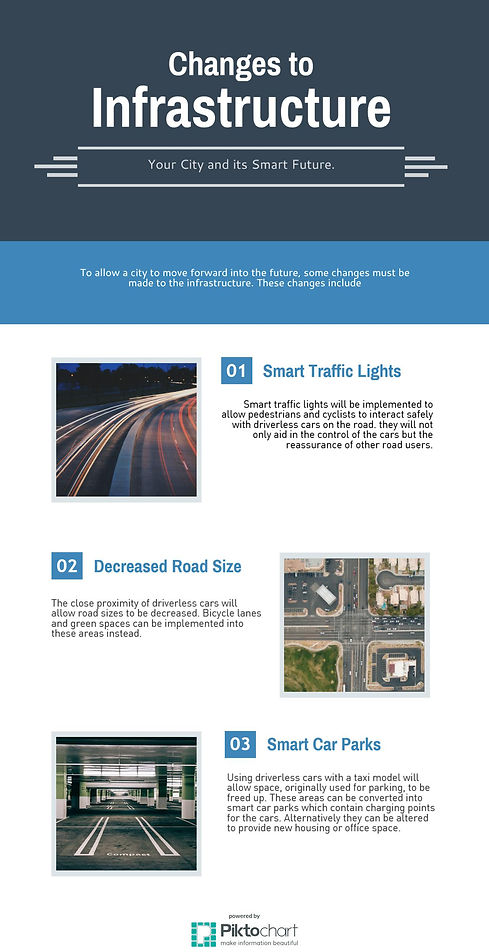
There will be a number of changes to the infrastructure of the highlighted roads to accommodate the successful introduction of driverless cars into the network, with the overall aim to expand these adapted areas to other parts of the city.
There will be a reduction of inner city car parks and introduction of smaller suburban smart car parks:
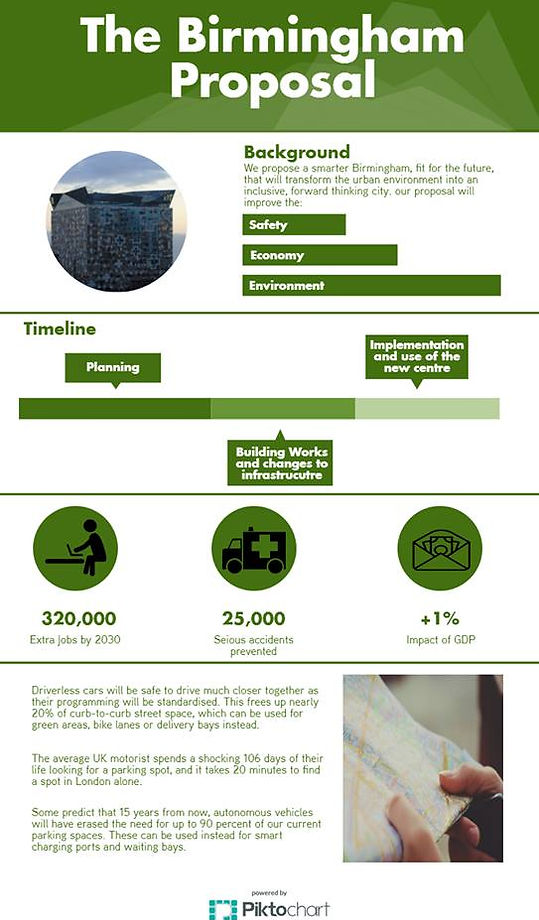
The nature of the introduction of driverless cars reduces the number and size of the car parks needed, as it has been suggested that 15 years from now driverless cars will have reduced the need for 90% of car parking spaces. For example, the lifts and staircases built into existing car parks would be made redundant and the cars can be parked closer together. We therefore propose the introduction of smaller suburban smart car parks which will offer refuelling, maintenance and contain internal intelligence allowing car parks to interact and share information with one another. This creates new openings in the inner city which can be used for green spaces, hence increasing the environmental quality of the city as well as expanding businesses and new residential areas, so to increase the rate of the city’s economic growth. For example the proposed usage of the NCP carpark for the Urban Wave Hub.
We will narrow lanes:
As driverless cars remove the concept of on street parking and also remove the aspect of human error from the road network allowing the cars to travel in a closer proximity to one another, we can consequently narrow the lanes that the cars travel in. This lane narrowing can free up to 20% of pavement-pavement space and so we propose the establishment of a continuous network of cycle lanes as roads become safer and more accessible, this also lends itself to the swift installation of the smart waiting bays and aspects of the green urban planning, such as street tree implantation which can be seen on the adjacent diagrams.
We will introduce smart traffic lights:
There will be an introduction of smart traffic lights that have an increased efficiency as no light output is needed for the benefit of the driver. At traffic crossings we would install integrated crossing stations that rely upon signals between the cars to maximise the flow of traffic. In the instance of pedestrian crossings, we install both an audio and visual signal for the assistance of the pedestrian to allow a safe crossing, with correspondence between cars again based upon signals for the coordination of the traffic flow.
OUR POLICIES AND THEIR ALIGNMENT WITH OTHER EXISTING STRATEGIES AND INFRASTRUCTURE
As we propose these major developments in Birmingham City Centre, our key aim is to align our outputs with current strategies and plans for the city and areas surrounding. As we narrow lanes and thus create a more complex cycle lane network, we increase the accessibility of inner city locations to cyclists which is a key aim of Transport for the West Midlands as well as Birmingham City Council’s “cycle revolution”. The areas of land that remain after the removal of redundant car parks will be used for the benefit of environmental cleanliness and/or economic development, including residential expansions. This supports the proposals of both Transport for West Midlands’ 10 year strategy, and Birmingham City Councils “Big City Plan” which includes enhancing the environmental quality of the city centre, improving connectivity and developing new residential areas, with their aim to remain in a “flexible approach to the evolution of land uses”.
The introduction of driverless cars and the infrastructure as proposed allows for a more integrated use of public and pre-existing methods of transport, thus offering increased mobility through the city due to the increased level of convenience. The idea of a door to door service using multimodal methods of transport, e.g. the use of trains, Midland Metro, bikes, buses and driverless cars, alongside the increased walkability of the city is the aim of the future and so this progressing integration is part of the bigger picture which we as Urban Wave ultimately work towards.
There will also be smart meters:
There will be strategically placed smart meters through the city that maximise the monitoring of waiting times at specific points where there is greatest congestion.
We will also present smart waiting bays:
We propose there to be a large number of smart waiting bays across the city which are placed on the sides of the roads, outside of main points of interest where the driverless cars can drop off and wait to collect passengers for small periods of time, as seen in the adjacent maps. These waiting bays will be depots for charging the electric autonomous vehicles, providing maximum efficiency and hence maximum usage of the cars to prevent them consequently yielding themselves redundant in the new smart car parks in peak times when they should be in use elsewhere.

"In recent years the focus in Birmingham has been on connecting all types of transportation."
